
Search the Knowledge Base
PowerCaptain App - Captain Performance & Speed Optimization
Last Updated: 28. August 2026
Article Cluster: Fuel & Operational Efficiency
Applies to: PowerCaptain | FuelExplorer
Author: Rick Broersma
About LionRock Maritime
LionRock Maritime provides highly accurate data and data-derived insights about tugboat operations across every port in the world. LionRock Maritime combines towage industry expertise, human creativity and data technologies to deliver decision-grade tugboat analytics software.
Executive Summary
- Problem: Tugboat fuel consumption is strongly influenced by captains speeding patterns during transit and non-operational sailing, often referred to as lightsailing. Small deviations from optimal speed, especially during mobilisation and demobilisation, can accumulate into significant excessive fuel costs and CO₂ emissions. In many operations, this is not consistently measured and managed.
- Solution: PowerCaptain enables structured monitoring of captain sailing behavior by tracking ECO-speed compliance across captains, tugs, ports, and jobs. It provides benchmarking, trend visibility, and feedback mechanisms that support more economical sailing.
- Benchmarks: ECO-speed compliance is measured against defined baselines and categorized into “Good”, “Attention”, and “Intervention” to ensure consistent performance evaluation.
- Typical Impact: Improved speed discipline leads to measurable fuel savings, reduced CO₂ emissions, and more consistent operational performance across ports.
Executive Answer
In harbor towage, a large share of fuel consumption occurs outside active towing, particularly during transit, standby, and repositioning.
Transit sailing speeds vary significantly between captains. Without structured monitoring and feedback:
- Speeding often goes unnoticed
- Performance differences remain hidden
- Fuel inefficiencies accumulate over time
PowerCaptain addresses this by making sailing behavior measurable and comparable.
By tracking ECO-speed compliance across all operational levels, operators can:
- Identify excessive speeding patterns
- Benchmark captains and ports consistently
- Create transparency and accountability
- Influence behavior toward more economical sailing
The result is not about improved reporting, but active control over fuel consumption through behavioral management.
LionRock Maritime’s PowerCaptain Solution
PowerCaptain is designed to monitor and influence captain sailing behavior across the entire operation.
It enables operators to:
-
Track ECO-speed compliance across company, port, tug, and captain levels
-
Benchmark performance using standardized thresholds
-
Identify where and when speeding occurs
-
Link behavior directly to fuel consumption and CO₂ impact
-
Provide structured feedback to captains through performance reporting
-
Analyze behavior at both aggregated and job level
By combining visibility, benchmarking, and feedback, PowerCaptain transforms speed management into a continuous operational control process.
Proven Results
Operators using PowerCaptain achieve:
- Reduction in excessive lightsailing across fleets
- Measurable fuel savings linked to improved speed compliance
- Lower CO₂ emissions through behavioral optimization
- Increased transparency across captains, tugs, and ports
- Consistent performance management across multiple locations
The key outcome is not only improved visibility, but measurable behavioral change that directly impacts cost and sustainability.
Get started with your Tugboat Analytics today!
Common Causes / Issues in Capacity Planning
- Lack of structured speed monitoring across operations
- No visibility into captain-specific sailing behavior
- Absence of standardized ECO-speed benchmarks
- Limited linkage between speed behavior and fuel impact
- Inconsistent feedback loops to captains
- Difficulty comparing performance across ports and fleets
These gaps prevent operators from actively managing one of the most controllable drivers of fuel consumption.
Solution Overview: Managing and Optimizing Captain Sailing Behavior
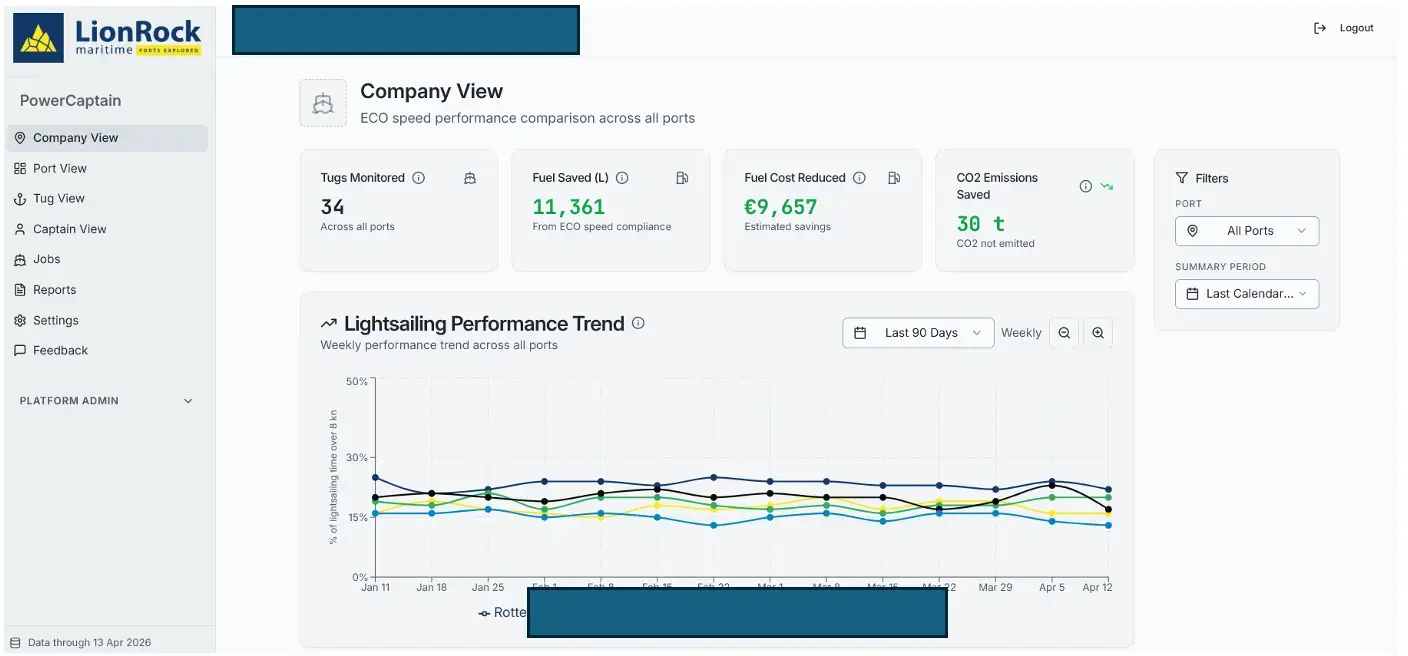
Fuel measurement becomes powerful when it is linked to business decisions. The four dashboards shown above represent the core strategic use cases.
Step 1: Company-Level Monitoring (Central Management View)
This view is designed for central management overseeing multiple ports.
It provides:
- Aggregated KPIs (tugs monitored, fuel saved, cost reduction, CO₂ savings)
- Lightsailing performance trends across ports
- Weekly/daily/monthly trend tracking
This allows management to:
- Track performance development over time
- Monitor fuel savings and efficiency improvements
- Identify overall behavioral trends rather than isolated cases
Step 2: Savings Tracking Across Ports
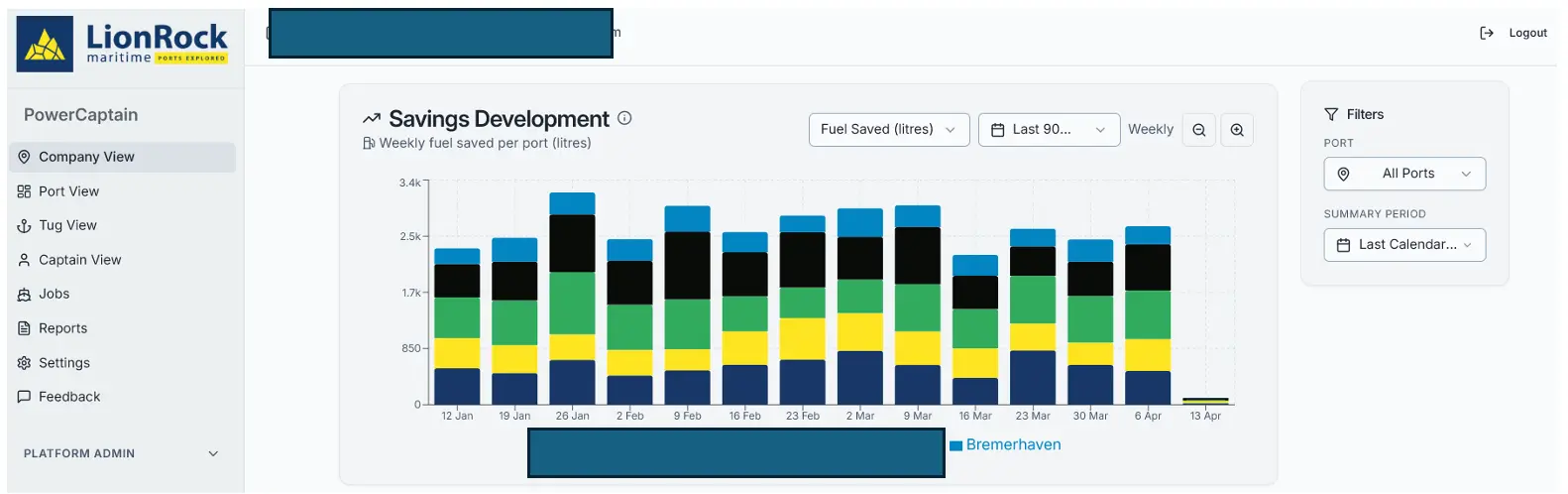
This section shows fuel savings development per port over time.
Key functionality:
- Weekly fuel savings tracking
- Port-level contribution to total savings
- Trend comparison across periods
This enables:
- Clear visibility into which ports are improving
- Tracking of fuel efficiency gains over time
Linking behavioral change directly to financial impact.
Step 3: Port-Level Performance Monitoring
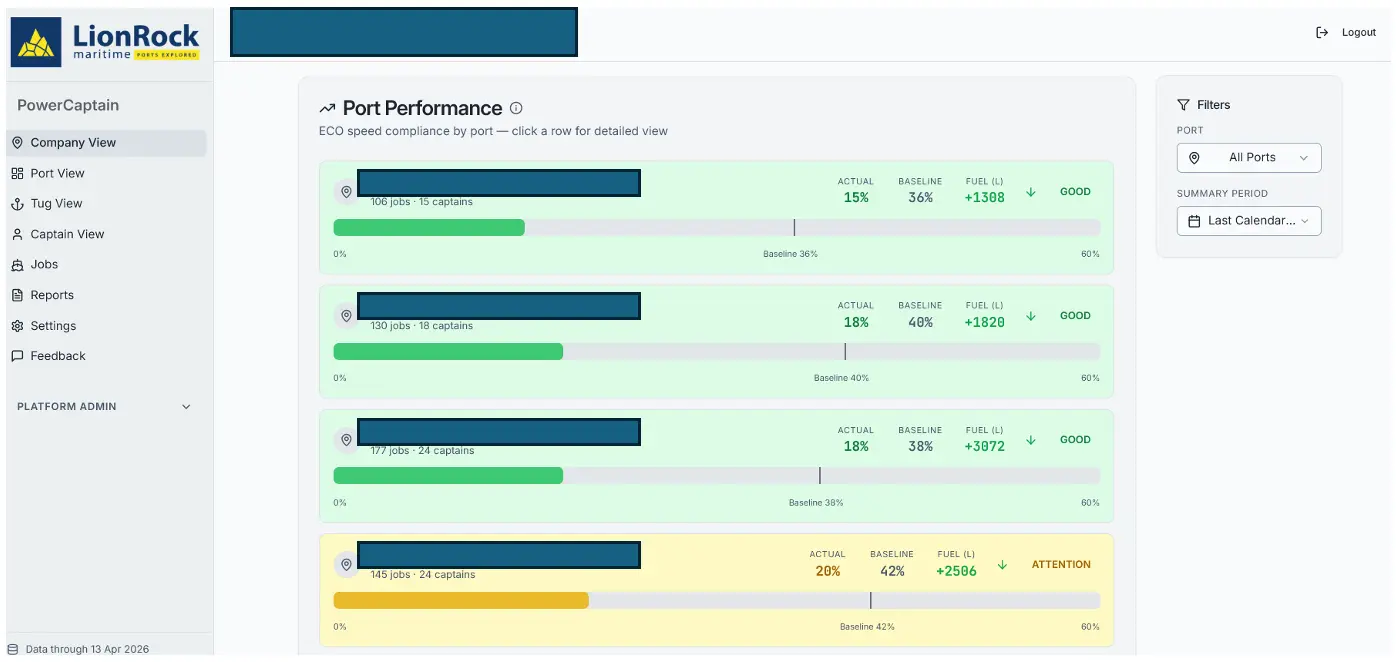
The port performance view provides:
- ECO-speed compliance vs baseline
- Fuel saved per port
- Performance classification (Good / Attention)
- Number of jobs and captains involved
This enables port managers to:
- Identify underperforming ports
- Compare actual vs baseline performance
- Focus attention where intervention is needed
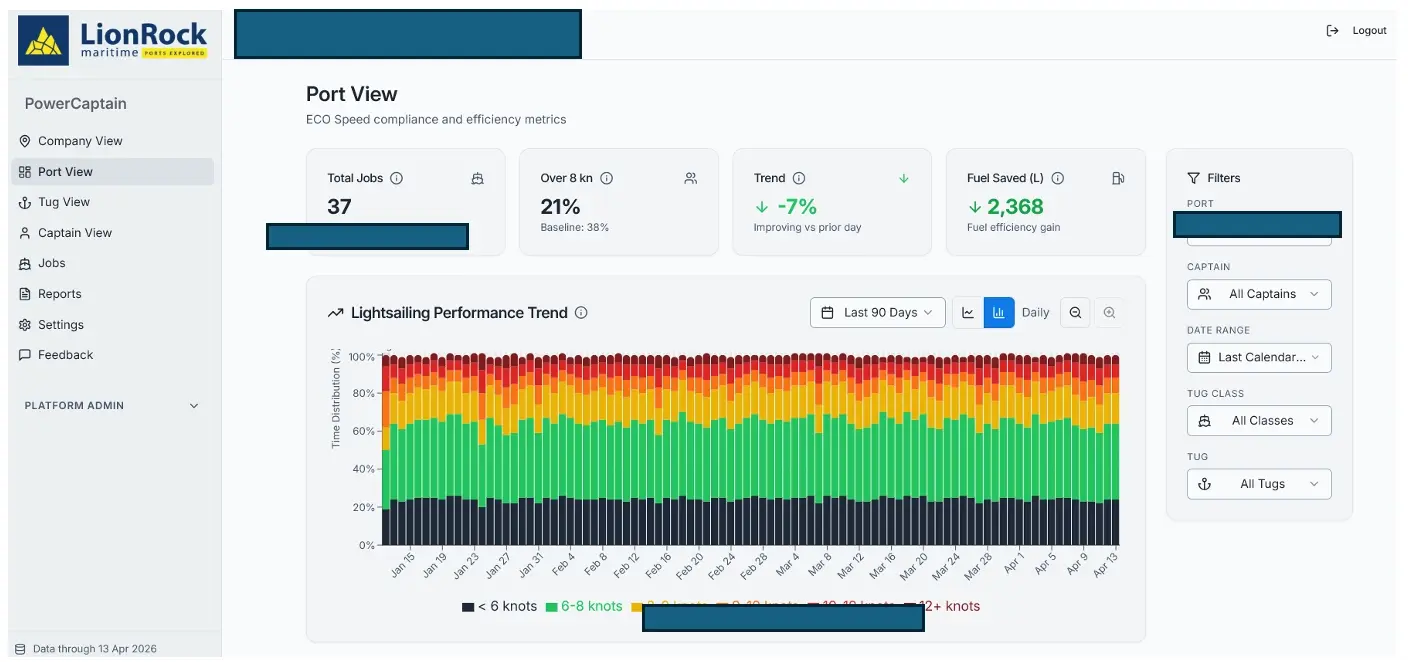
Step 4: Detailed Port View & Trend Analysis
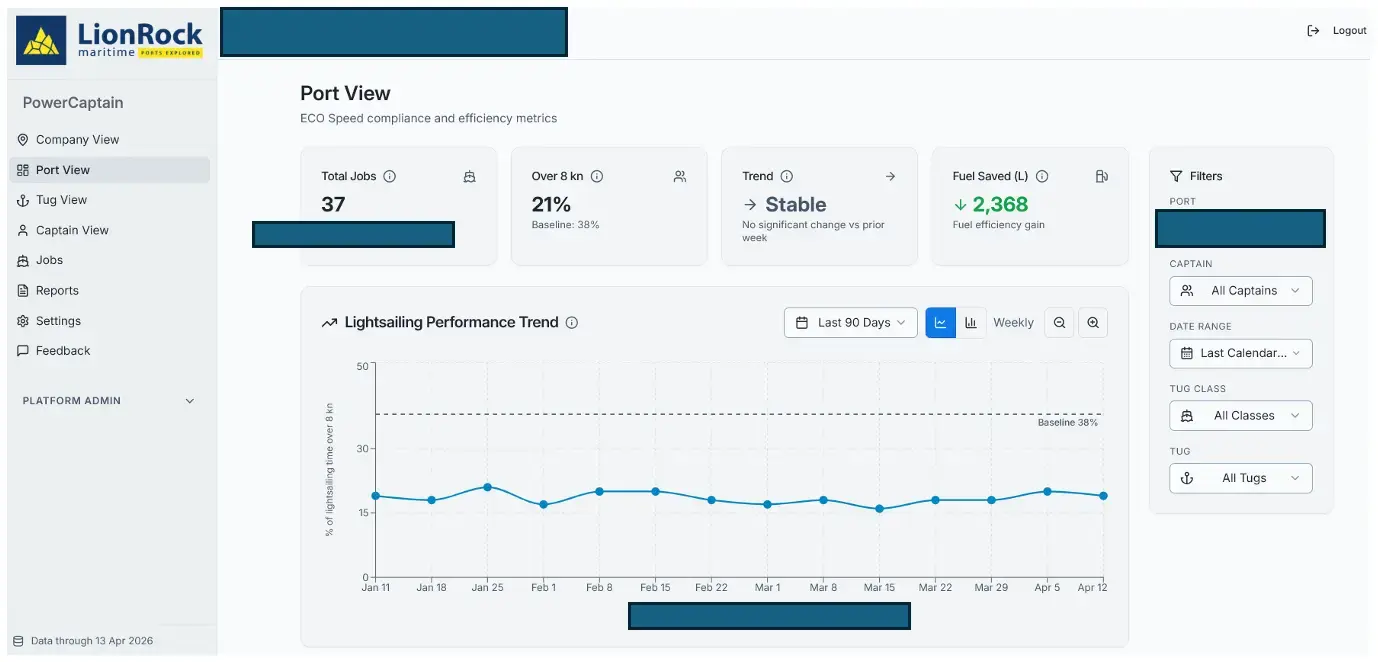
Within each port, users can:
- Analyze lightsailing performance trends over time
- View speed distribution across intervals
- Filter by captain, tug, class, and time
This allows:
- Identification of speeding patterns
- Monitoring of improvements vs baseline
- Deeper understanding of operational behavior
Step 5: Optimize Fleet Deployment
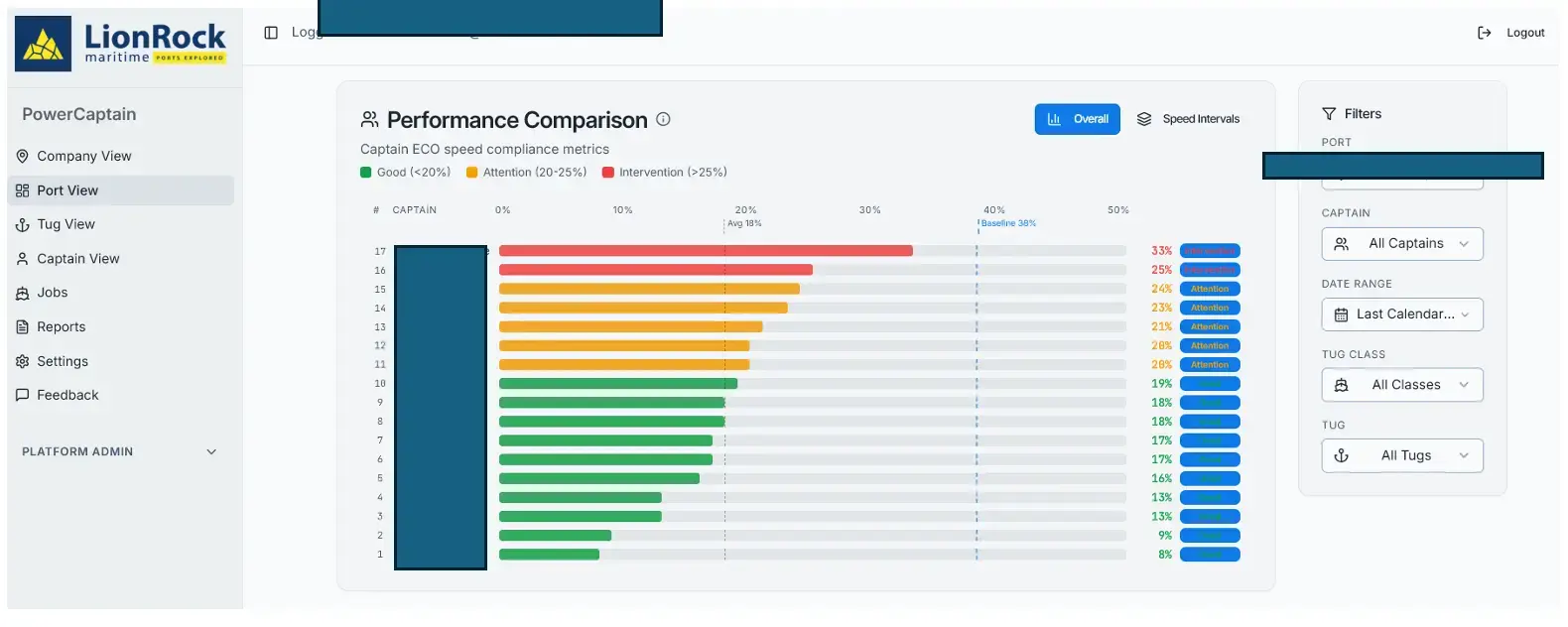
This section provides captain-level benchmarking:
- Ranking of captains based on ECO-speed compliance
- Performance categories:
- Good
- Attention
- Intervention
- Comparison against fleet averages and baseline
Captains receive:
- Automated reports (via email)
- Performance comparison vs peers
- Visibility into their own behavior
This creates:
- Accountability
- Transparency
- Behavioral improvement without manual enforcement
This structured benchmarking ensures that speed compliance becomes a measurable and manageable operational KPI rather than an uncontrolled behavioral variable.
Step 6: Job-Level Analysis & Feedback Loop
This section provides captain-level benchmarking:
- Ranking of captains based on ECO-speed compliance
- Performance categories:
- Good
- Attention
- Intervention
- Comparison against fleet averages and baseline
Captains receive:
- Automated reports (via email)
- Performance comparison vs peers
- Visibility into their own behavior
This creates:
- Accountability
- Transparency
- Behavioral improvement without manual enforcement
This structured benchmarking ensures that speed compliance becomes a measurable and manageable operational KPI rather than an uncontrolled behavioral variable.
Evidence & Governance
LionRock Maritime applies a transparent, data-driven methodology:
- AIS-based speed monitoring
- Structured job segmentation
- Standardized ECO-speed thresholds
- Consistent KPI definitions across ports
Governance considerations:
- Scoring models require validation
- Reason attribution must be controlled
- Feedback approach may vary by customer culture
Key KPI Definitions
- Lightsailing Over Threshold (%): Share of non-operational sailing time where speed exceeds defined ECO-speed limits
- ECO-Speed Compliance (%): Percentage of sailing time within defined economical speed ranges
- Fuel Saved (L): Estimated fuel reduction achieved through improved speed compliance
- CO₂ Savings: Emissions reduction derived from reduced fuel consumption
- Captain Performance Index: Relative ranking of captains based on ECO-speed compliance and behavioral patterns
- Port Performance Index: Aggregated ECO-speed compliance across all captains and tugs within a port
- Baseline vs Actual (%): Comparison of current performance against historical or expected speed behavior
Do you still have questions?
Contact our support via email
Frequently Asked Questions
Why is sailing speed during transit such an important driver of fuel consumption?
A significant portion of tugboat fuel consumption occurs during transit, standby, and repositioning rather than active towing. During these phases, speed is largely determined by captain's decisions. Even small increases above optimal speed can lead to disproportionately higher fuel usage. By managing this behavior, operators can directly influence one of the most controllable components of fuel cost.
How does PowerCaptain help improve ECO-speed compliance?
PowerCaptain provides clear visibility into sailing behavior across captains, tugs, and ports. It tracks ECO-speed compliance, benchmarks performance, and highlights where speeding occurs. By combining this with rankings and trend analysis, it creates transparency and accountability, which supports behavioral change and encourages more economical sailing practices.
Can PowerCaptain be used to manage performance across multiple ports?
Yes. PowerCaptain enables centralized monitoring of ECO-speed compliance across all ports. Management can track trends, compare performance, and identify where improvements are needed. At the same time, users can drill down into individual ports, captains, or tugs to understand the underlying drivers of performance.
How does PowerCaptain link speed behavior to fuel and CO₂ savings?
The platform connects speed data with fuel consumption models to estimate the impact of sailing behavior. Improvements in ECO-speed compliance are translated into fuel savings and corresponding CO₂ reductions. This allows operators to quantify the financial and environmental benefits of improved captain behavior and track progress over time.
Related Articles
Tugboat News
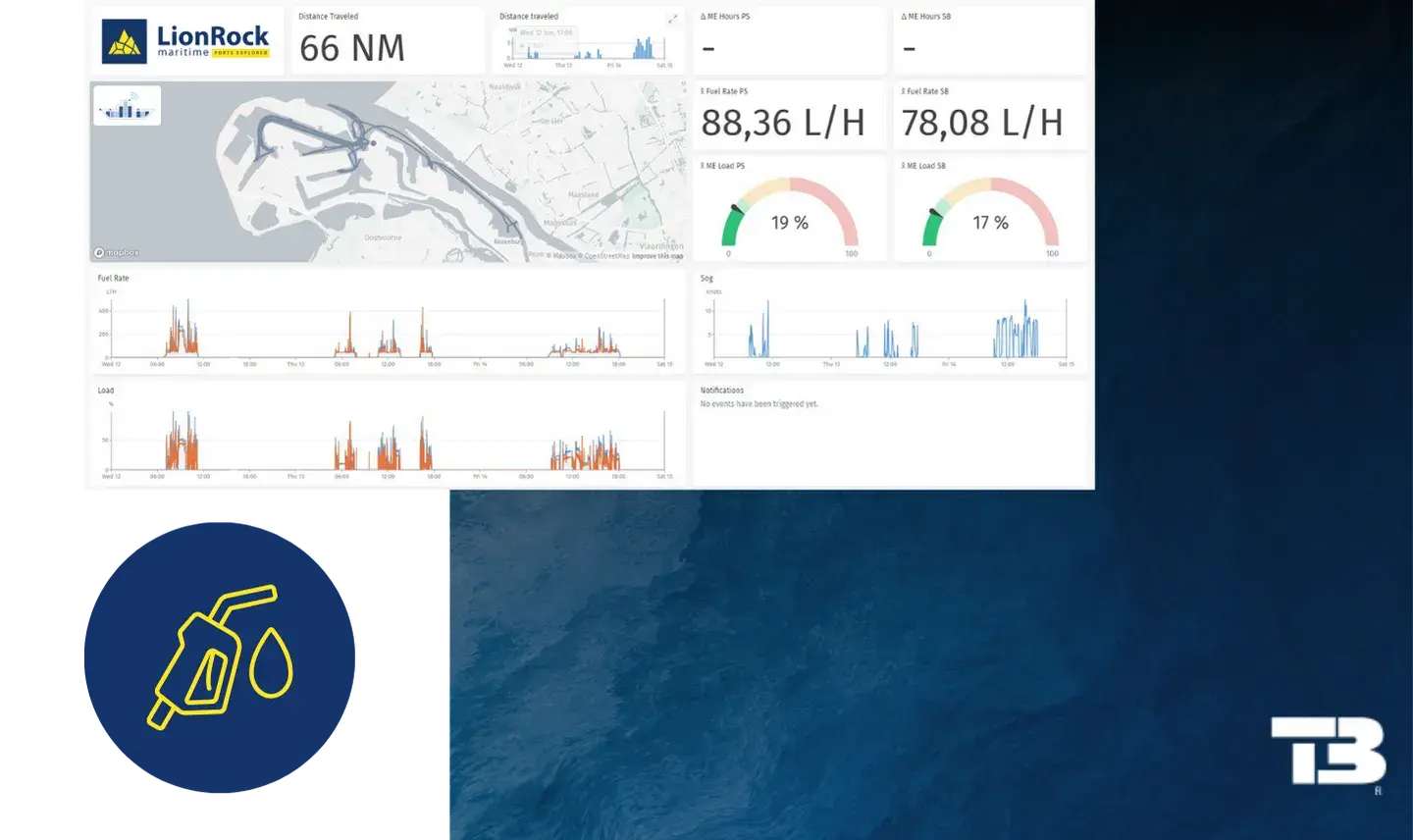
Tugboat Speed Optimization
Optimizing tugboat speed remains crucial even with alternative fuels due to factors like cost, emissions, and energy storage constraints. Learn more about sustainable maritime oper
Tugboat News
How to Become a Tugboat Captain | Training and Career Guide
Learn how to become a tugboat captain in 2025. Discover essential captain training, certifications, and job opportunities in tugboat captain careers.

Tugboat News
Tugboat Towing Operations: Achieving optimal fuel consumption
A guide to understand tug boat fuel consumption: the impact of managing speed, maneuvering and tugboat characteristics in optimizing consumption in tugboat towing.