
Search the Knowledge Base
Tug Capacity Tool – Fleet Utilization & Capacity Planning
Last Updated: 28. August 2026
Article Cluster: Capacity Planning & Fleet Strategy
Applies to: PortCaptain
Author: Rick Broersma
About LionRock Maritime
LionRock Maritime provides highly accurate data and data-derived insights about tugboat operations across every port in the world. LionRock Maritime combines towage industry expertise, human creativity and data technologies to deliver decision-grade tugboat analytics software.
Executive Summary
- Problem: Running a tugboat business in a competitive port set-up is potentially a low margin game, where lowest cost operators will survive. Tug utilization drives unit cost so not surprisingly tug operators focus there. That sounds easier said than done; on one hand there is a trade-off between service delivery to customers and port stakeholders who often demand on-time delivery and running a tight ship. On the other hand there is the difficulty in evaluating the impact of commercial decisions on future tug utilization. I.e. can I get that other customer on board with the fleet I have or would it require getting more tugs? Or which of my current customers excessively contribute to peak demand and should I maybe let go? These are difficult questions to answer and require information about total market job volumes, duration, tug usage beyond your own job data as well as decision support analytics to help with these trade-offs.
- Solution: The Tug Capacity Tool, powered by LionRock Maritime, provides structured insights into tug concurrency, job distribution, and zone-level demand.
- Use Cases:
- Peak capacity planning
- Commercial scenario analysis
- Fleet right-sizing
- Operational bottleneck identification
-
Outcome: Operators can align fleet deployment with real demand, improve utilization, and support data-driven commercial and operational decisions.
Executive Answer
The Tug Capacity Tool enables operators to understand Effective tug capacity planning compares real port demand with the number, type, availability, and tug bollard pull of the vessels in the fleet. The goal is to understand whether the operation can meet peak demand safely without carrying too much idle capacity during quieter periods. AIS-based job detection helps make that balance visible.:
Executive answer
What makes tug capacity planning reliable?
Reliable tug capacity planning compares real demand with vessel availability, tug bollard pull, job complexity, and peak concurrency. AIS-based activity data shows whether a port needs more capacity, different tug classes, or better deployment.
- Peak tug concurrency (how many tugs are needed simultaneously)
- Job distribution across zones and terminals
- Capacity pressure over time and location
- Impact of commercial or operational changes
By analyzing simultaneous tug activity and job intensity, operators can:
- Identify when and where capacity constraints occur
- Evaluate the impact of new customers or terminals
- Optimize fleet size and deployment strategy
LionRock Maritime Tug Capacity Tool
The Tug Capacity Tool transforms operational activity into capacity intelligence by combining:
- Job-level data
- Tug activity timelines
- Geographic segmentation (zones/terminals)
- Customer and operator filters
It provides a clear view of how fleet demand behaves in reality, not just in planning assumptions.
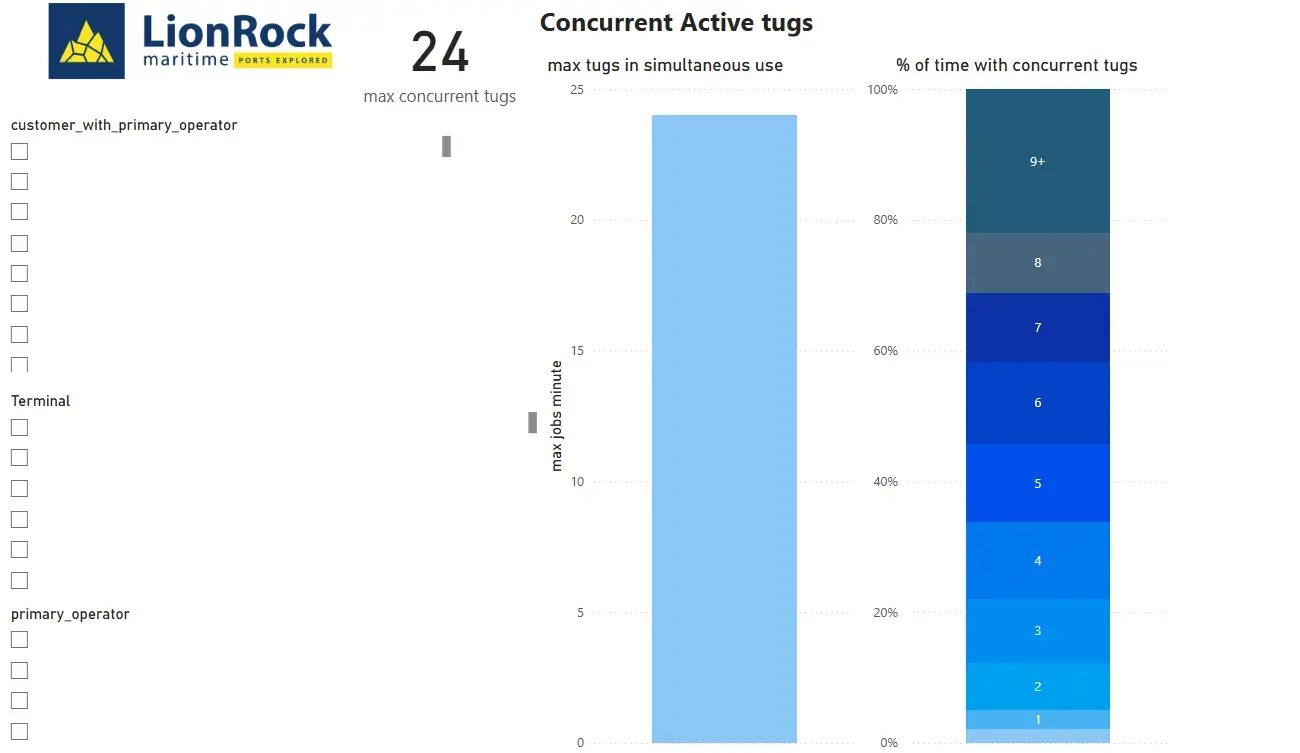
Insight 1: Peak Capacity Requirements
This insight visualizes the number of tugboats operating concurrently across all terminals.
Key outputs:
- The maximum number of tugs used at the same time
- Frequency of concurrency levels
- Distribution of peak demand events
What this enables:
- Define the required fleet size for peak operations
- Identify overcapacity or undercapacity
- Understand how often peak scenarios occur
This moves planning from “average demand” to real peak-driven capacity management.
Insight 2: Commercial Scenario Impact Assessment
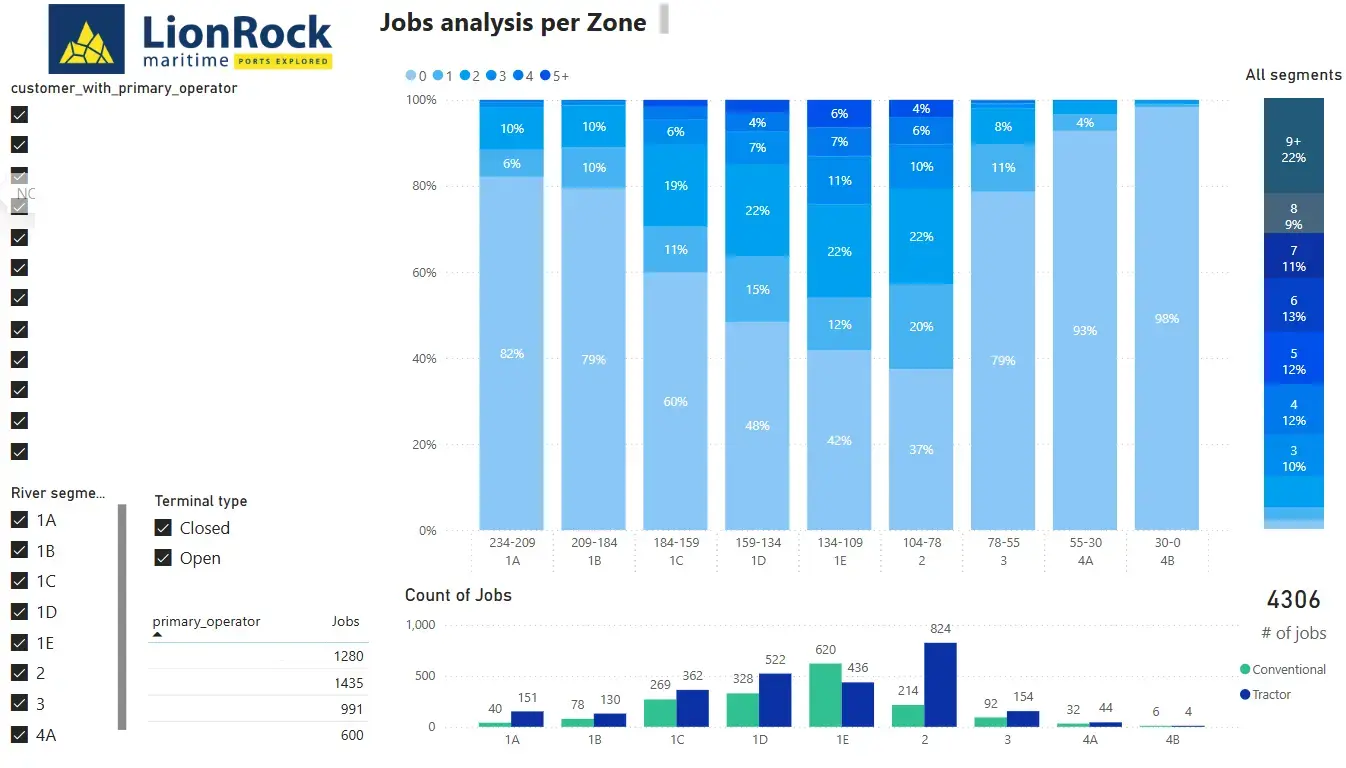
This dashboard analyzes how job complexity and frequency vary across port zones.
Key outputs:
- Distribution of jobs requiring 1, 2, 3+ tugs
- Zone-level demand differences
- Terminal-type comparison (open vs closed)
- Tug type segmentation (e.g., conventional vs tractor)
What this enables:
- Evaluate impact of new terminals or customers
- Understand geographic demand shifts
- Support commercial planning decisions
- Optimize fleet composition
Operators can simulate changes and assess how demand patterns evolve across the port.
Proven Results
Using the Tug Capacity Tool, operators can:
- Identify peak concurrency requirements with precision
- Detect operational bottlenecks across zones
- Align fleet size with real demand patterns
- Evaluate commercial growth scenarios before execution
- Improve overall fleet utilization
This transforms fragmented operational data into structured capacity planning insights.
Get started with your Tugboat Analytics today!
Common Causes / Issues in Capacity Planning
- Planning based on averages instead of peak demand
- No visibility into simultaneous tug usage
- Lack of zone-level demand segmentation
- Limited understanding of job complexity distribution
- Reactive fleet allocation instead of proactive planning
These gaps often lead to overcapacity, underutilization, or operational bottlenecks.
Solution Overview: How to Use the Tug Capacity Tool
Fuel measurement becomes powerful when it is linked to business decisions. The four dashboards shown above represent the core strategic use cases.
Step 1: Analyze Peak Concurrency
Use concurrency dashboards to identify:
- Maximum simultaneous tug usage
- Frequency of peak events
- Time-based demand patterns
This defines the true fleet requirement baseline.
Step 2: Segment Demand by Zone and Terminal
Break down activity by:
- Port zones
- Terminals
- Customer segments
This reveals where capacity pressure builds geographically.
Step 3: Evaluate Job Complexity
Analyze:
- Number of tugs required per job
- Distribution of job intensity
- Differences across terminals
This helps understand what drives demand, not just how much.
Step 4: Simulate Commercial Scenarios
Model:
- New customer volumes
- Terminal expansions or closures
- Changes in vessel mix
This enables forward-looking capacity planning.
Step 5: Optimize Fleet Deployment
Use insights to:
- Adjust fleet size
- Reallocate tugs across zones
- Align assets with demand patterns
This ensures maximum utilization and operational reliability.
Evidence & Governance
The Tug Capacity Tool is built on:
- Structured job-level towage data
- AIS-derived tug activity
- Standardized operational segmentation
- Repeatable analytics across ports
All outputs are based on actual operational behavior, ensuring reliability for planning and decision-making.
Key KPI Definitions
- Peak Tug Concurrency: Maximum number of tugs active simultaneously
- Concurrency Frequency (%): How often specific concurrency levels occur
- Jobs per Zone: Distribution of jobs across port areas
- Job Intensity: Number of tugs required per job
- Fleet Utilization Rate: Active tug time relative to total availability
- Capacity Pressure Points: Time/locations where demand exceeds typical levels
Do you still have questions?
Contact our support via email
Frequently Asked Questions
What is peak tug concurrency and why does it matter?
Peak tug concurrency is the maximum number of tugs operating simultaneously within a port or terminal. It defines the true fleet size required to meet demand, not the average. LionRock Maritime’s Tug Capacity Tool allows operators to identify these peak moments and understand how often they occur, ensuring fleets are sized for reliability without excessive overcapacity.
How does the Tug Capacity Tool support commercial decision-making?
The Tug Capacity Tool links operational demand with commercial scenarios. By analyzing job distribution, tug requirements, and zone-level demand, operators can assess whether adding a new customer or terminal will increase peak pressure or can be absorbed by the existing fleet. This enables more informed decisions on customer selection, pricing, and contract negotiations.
Can the Tug Capacity Tool help identify inefficient fleet utilization?
Yes. By visualizing concurrency patterns, job intensity, and geographic demand, the tool highlights where tugs are underutilized or where bottlenecks occur. This allows operators to rebalance deployment, reduce idle time, and improve overall fleet utilization without compromising service levels.
How is this different from using internal operational data only?
Internal data typically shows only your own jobs, which limits visibility into broader demand patterns. LionRock Maritime’s Tug Capacity Tool incorporates market-level job data, AIS activity, and standardized segmentation, providing a complete view of demand across the port. This enables more accurate capacity planning and avoids decisions based on incomplete information.
Related Articles

Tugboat News
Optimal Tugboat Allocation: Matching Tugs to Ports and Jobs using Data
Optimize tugboat allocation with data-driven insights to reduce costs, improve port efficiency, and enhance fleet deployment for long-term operational success.
Tugboat News
Evaluating Tugboat Specifications with Market Data Insights
Optimize tugboat performance using market data for better efficiency, safety, and compliance. Discover key specifications and insights for informed decision-making in maritime oper
Tugboat News
Leveraging Market Insights For Tugboat Fleet Expansion | Based on Data
Optimize your tugboat fleet with LionRock Maritime’s Tug Capacity Tool. Make data-driven decisions for efficient, profitable fleet expansion and ensure regulatory compliance.